

How to qualify the site, build the business case and choose the right storage format for your C&I client
Your C&I clients are asking about battery storage, but the right answer is not always simply “add a battery”. The business case, site conditions, access, available space and load profile all influence what type of BESS makes sense.
For installers and EPCs, that creates an opportunity. The partners who can qualify a site properly, explain the commercial value clearly and recommend the right format are better positioned to turn storage interest into viable projects.
Containerised and cabinet-based battery energy storage systems can provide an efficient, scalable approach for many C&I applications. This guide covers the benefits to discuss with your client, the questions to ask before proposing a solution, when a container may not be suitable, and how IBC SOLAR can support you from assessment through to delivery.
First, understand the different BESS formats
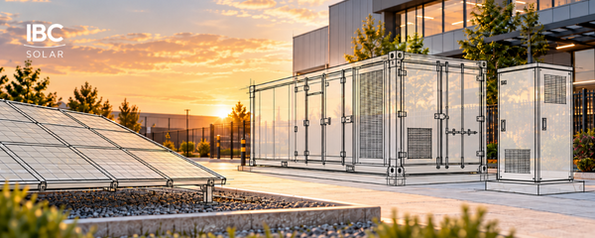
Clients often picture a 40-foot shipping container when they hear “BESS”, but commercial storage can take several forms:
- A full-size container for multi-MWh projects
- A compact outdoor cabinet for a factory, farm, school or retail centre
- A bespoke enclosure sized around a specific site and load profile
- Rack-based systems installed inside a suitable plant room or building
The right format depends on the site, load profile, required capacity, access, safety requirements and future expansion plans.
Six reasons C&I clients are considering BESS
1. Faster installation, less disruption
The batteries, battery management, power conversion, cooling and protection arrive integrated and tested. Depending on the project, much of the integration can be completed before the system reaches site, reducing the amount of installation work required on the client’s premises.
Tell your client: “Most of the work is done in the factory, not on your premises.”
2. Safety engineered in
Purpose-built enclosures come with thermal management, fire detection and suppression, and separation from occupied buildings designed in from the start. Purpose-designed systems can incorporate thermal management, monitoring, detection, protection and fire-mitigation measures as part of the overall system design. The applicable safety and compliance requirements should be assessed for each project and site.
Tell your client: “Safety and thermal management form part of the system design from the outset.”
3. Sized to the business, and ready to grow
A modular approach lets the client start with what today’s demand profile needs and add capacity as loads grow, tariffs change or more PV is installed.
Tell your client: “A modular design can give you more flexibility to expand as your energy requirements grow.”
4. A clear business case
A BESS should solve a defined business problem. Depending on the client’s tariff, load profile and operating requirements, storage can support:
- Peak management: reducing reliance on grid power during expensive periods.
- Demand management: helping control peak demand where the tariff structure makes this commercially relevant.
- Solar optimisation: storing excess solar generation for use later in the day.
- Energy resilience: supporting critical operations during grid interruptions or supply constraints.
The value of each use case must be assessed against the client’s actual load profile, tariff structure, PV system and operating requirements.
Tell your client: “The question is no longer only how much energy you use, but when you use it and where it comes from.”
5. Security for a high-value asset
Theft and vandalism of energy equipment is a real risk, especially on remote or unattended sites. A steel container or cabinet provides a lockable perimeter around the whole system and can be fitted with reinforced doors, intrusion alarms, remote monitoring, CCTV and access control.
Tell your client: “A secured enclosure creates an additional physical barrier around high-value equipment and can be integrated with site security and remote monitoring.”
6. Relocatable
A self-contained system may offer greater flexibility if the client relocates or repurposes a site, subject to system design, transport requirements, grid connection and the suitability of the new location.
Tell your client: “A self-contained system can give you more flexibility if your site requirements change.”
Qualify the site before you propose
Before discussing product, qualify the application and the site.
The best proposals start with the right questions. Before recommending an enclosure, check:
- Objective: What problem is the client actually trying to solve, backup, tariff optimisation, demand management, increased solar self-consumption, grid constraints or a combination?
- Load and tariff: What does the load profile look like, and what is the client paying in energy and demand charges?
- Space: Is there a clear, level area with the required safety clearances?
- Access: Can a heavy truck reach the site? Are there gravel roads, low bridges, tight turns or weight-restricted routes?
- Lifting: Is a crane of the right size available locally, and is there room to set it up?
- Existing buildings: Is there a plant room or outbuilding with good ventilation, fire separation and security that could house the system?
- Security: Is the site attended? What is the local theft and vandalism risk?
- Ownership: Does the client own the property or lease it? Does the landlord need to approve?
- Growth: Are loads, operations or PV capacity likely to grow?
This is where early project qualification matters. IBC SOLAR can support installers and EPCs in assessing the application, load profile, site conditions and technical requirements before a system format is selected. The objective is not to start with a particular product, but to identify the solution that best fits the client and the site.
When a container is not the right answer
The right response is not to force a container onto the site. It is to adapt the system architecture.
Containers are not right for every site, and being honest about that builds trust with your client. Three situations come up regularly:
- Access and logistics. Larger BESS units can create significant transport and lifting requirements. Remote farms, mines and rural sites may have access routes, bridges, turning areas or lifting constraints that affect the system format.
- No space. Dense urban and industrial sites often have no clear area for a container, its clearances and crane access.
- A suitable building already exists. An existing plant room or outbuilding with good ventilation, fire separation and security can be quicker and cheaper than placing a new enclosure.
The answer is not to abandon the turnkey approach, but to change the format:
- Smaller modular cabinets that travel on a standard truck and can be placed with a forklift or small crane
- Systems delivered in sections and assembled on site where access rules out a single heavy unit
- Rack-mounted systems installed in a suitable building, designed with proper ventilation, thermal management, fire protection and access control
Let the site decide the enclosure, not the catalogue.
Five questions your client is likely to ask
1. “If load shedding has eased, why invest in storage?”
Because the business case for storage can extend beyond backup. Depending on the site, BESS can support tariff optimisation, demand management, solar self-consumption and resilience.
2. “How do I know what size battery I need?”
Start with the load profile and the business objective. A battery should be sized around the application, not selected from a catalogue first. This is an area where IBC SOLAR can support you with load profile analysis, system sizing and solution design.
3. “What about safety?”
Safety should form part of the system design, including thermal management, monitoring, protection, separation and the applicable site-specific requirements.
4. “We don’t have room for a container.”
You may not need one. Cabinet-based or in-building solutions may be better suited to sites with limited space or access.
5. “What happens if our energy requirements change?”
Depending on the technology and system architecture, a modular approach may allow the system to be expanded or adapted over time.
How IBC SOLAR supports you
You own the client relationship and the installation. We help you deliver it with confidence:
- Site assessment: access, space, ventilation and security reviewed up front, so the right format is chosen
- Design and sizing: load profile analysis, system sizing and integration with new or existing PV
- Complete system solution: containers, cabinets or in-building architectures configured around the project requirements
- Supply and logistics: the stock, scheduling and delivery that larger projects demand
- Commissioning and after-sales support: so you and your client are never on your own
The bottom line
Battery storage is becoming an increasingly important part of the C&I energy conversation. But successful BESS projects start long before the equipment arrives on site.
They start with the right questions, a clear understanding of the client’s load profile and business objective, and a system architecture that fits the site.
For installers and EPCs, that expertise is becoming a competitive advantage.
Have a client considering battery storage?
Send us the site details and load profile. Our team can help you assess the application, identify the right system format and build the solution with you.
Fredrik Hagelberg
Managing Director, IBC SOLAR South Africa