
Part 1/3: Why Good Solar Projects Don't Get Approved
02/06/2026 – by Fredrik Hagelberg, MD, IBC SOLAR
Despite lower equipment prices, proven technology and attractive payback periods, many commercial solar projects in South Africa never get built.
The reason is often not technical. It's financial.
Not so long ago, solar PV, as an energy-saving solution for the C&I sector, was highly specialised, requiring specialised knowledge to design and install systems. It was also expensive. I can remember some clients accepting up to 10-year payback periods for their systems, assuming a 20-year lifespan for grid-tied rooftop PV solutions! Those days are long gone. This was before any of third-party funding was available and only those businesses with deep pockets and access to cheap capital could afford the investment.
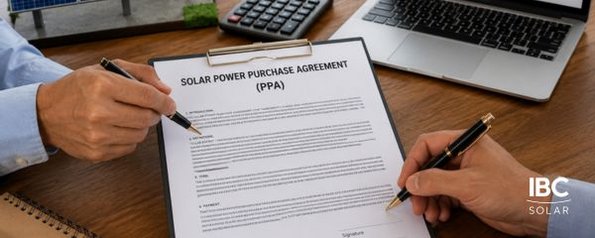
Depending on who you ask or read in industry media, today at least 50% of all C&I projects are funded by third parties, with the PPA (Power Purchase Agreement) currently the most popular mechanism. I don't include normal debt funding that businesses can secure from their commercial banks in this regard.
Today, the technology is proven, and prices have reduced substantially over the past decade. The products themselves are becoming commoditised, and in particular, solar PV panels. Some brands are even household names. Skilled installers and EPCs operate across the country, and there is no shortage of businesses looking to reduce their electricity costs. Payback periods of less than 5 years are commonplace.
Yet despite all of this, a surprisingly large number of technically and financially viable projects never reach implementation. Often, the biggest obstacle facing solar projects is access to capital or alternative funding options.
Over the past few years, South African businesses have faced increasing pressure on cash flow.
Rising operating costs, inflationary pressures, higher interest rates, supply chain challenges and broader economic uncertainty have forced management teams to become far more selective about how they deploy capital.
As a result, even projects that demonstrate excellent returns on investment often struggle to secure approval.
Consider a typical manufacturing facility spending R300,000 to R500,000 per month on electricity. A well-designed solar PV system could reduce electricity costs significantly while delivering attractive returns over its operating life. On paper, the investment appears obvious. However, the reality inside the boardroom is often very different.
Management may be comparing the solar investment against inventory expansion, production equipment upgrades, fleet replacement, warehouse improvements or acquisitions. While solar may offer attractive returns, it is frequently competing for capital against initiatives directly linked to revenue growth.
For many financial directors, business owners or managers, the question is not whether solar makes financial sense. The question is whether solar represents the best use of available capital at that particular point in time. Many remain reluctant to invest several million rand into an energy asset when that same capital could support business growth, improve liquidity or strengthen working capital reserves.
In these situations, installers often find themselves trapped in lengthy quotation cycles. Detailed proposals are prepared, site visits conducted and designs completed, only for projects to stall indefinitely.
The challenge is not that the customer dislikes the solution.
The challenge is that the funding model does not align with the customer's financial reality.
Historically, successful installers differentiated themselves through technical expertise, product selection and installation quality. These remain important factors, but they are increasingly becoming minimum requirements rather than true differentiators.
The installers and EPCs winning projects today are often those that can provide their clients support on how projects can be funded other than just CAPEX or bank debt.
Clients are starting to ask different questions:
- Can this project be funded off balance sheet?
- Can we be cash flow positive without spending our own capital?
- Can maintenance and performance risks be transferred?
- Can we structure payments to align with cash flow?
These questions have little to do with PV design or technology choices in a proposal. They are fundamentally financial questions.
As the South African market continues to evolve, installers who understand financing structures will have a significant competitive advantage over those who focus exclusively on technology.
The future of solar adoption may depend less on engineering innovation and more on financial innovation.
One important shift often overlooked by both installers, EPCs and clients is the nature of the relationship between the various parties in a funded PV project.
In a traditional project, the installer manages the client relationship from start to finish.
In a funded project, the installer must now satisfy two customers:
- The client
- The funder
Both need confidence that the project will be delivered on time, within budget and according to expectations. This changes how projects are sold, managed and delivered.
In the traditional model, the installer or EPC owns the client relationship. The installer has either been referred by another client or acquaintance, responded to a tender or promoted themselves through their own marketing efforts. They are there from start to finish of the project and must manage the client relationship.
With the introduction of a third-party funder, the installer now must satisfy two parties, namely the client and the funder, who will ultimately own the asset (depending on the funding mechanism). It will result in the installer having to satisfy the funder’s expectations including installation schedules, costs, quality and ongoing O&M services as well as performance guarantees, possibly.
The funder will take over the client relationship as the counterparty to the contract with the client, delivering a utility and service.
The installer or EPCs must come to terms with this changing relationship dynamic and prepare themselves as well as their client to avoid any misunderstandings and manage expectations.
Keep in mind that installers and EPCs typically sold the cost savings (aside from energy security during load shedding) as a Return on Investment of their solar PV asset. IPPs and funders offer pure financial savings by offering an energy as a service along with other benefits, including guaranteed energy performance, maintenance and insurance for example.
Offering funding might unlock projects that were going nowhere, but it can complicate matters, so installers need to improve their funding knowledge to help their clients move forward with their project.
Understanding funding is no longer a specialist skill reserved for financiers. It is becoming a core competency for successful solar PV installers.
In the next article, I will summarise some of the more common funding models available to South African businesses and examine how ownership, leasing, rent-to-own and PPA structures each address different business objectives.